Useful Information regarding the so-far confirmed international journal can be found
below:
- Aerospace - Open Access Journal
Aerospace is an international, peer-reviewed , open-access
journal devoted to the publication of original papers, review articles, short notes and
communications related to all fields of aerospace science, engineering and technology, disclosing
theoretical, fundamental and applied results linked to potential applications that are related to
research, design, manufacture, operations, control and maintenance of aircraft and spacecraft.
- Aerospace ISSN: 2226-4310
- Aerospace is indexed: within
Scopus (2023 CiteScore: 3.0), SCIE (Web of Science), Inspec and many other databases. More information regarding
AEROSPACE indexing can be found here
Useful Information & Submission Guidelines:
Aerospace Journal is Open Access — free for readers, with article
processing charges (APC) paid by authors or their institutions.
The European Aeronautics Science
Network (EASN) is affiliated with Aerospace, herefore prospective authors
will receive a discount on the article processing charges, as following:
- discount of 30% for non-EASN members
-
discount of 50% for the EASN members (Join the EASN)
Special Issue: 13th EASN International Conference on Innovation in Aviation
& Space for Opening New Horizons
Authors are able to submit directly their paper to the online registration
platform
of the Aerospace journal. Authors need to register to the editorial system
if they are new users. The submission system is currently open and can be found here
Submission deadline: 15.12.2023
Useful Links
-
Aircraft Engineering and Aerospace Technology (AEAT)
The Aircraft Engineering and Aerospace Technology (AEAT)
journal provides broad coverage of the materials and techniques employed in the aircraft and
aerospace industry. Its international perspectives allow readers to keep up to date with current
thinking and developments in critical areas such as coping with increasingly overcrowded
airways, the development of new materials, recent breakthroughs in navigation technology - and
more. Selected papers which will be presented during the upcoming 13th EASN International
Conference will consist of a special issue under the title
"Innovation in Aviation & Space for opening New Horizons".
- AEAT ISSN: 0002-2667
-
AEAT is indexed: within Scopus(2021 CiteScore: 1.9) and many other databases. More
information regarding AEAT indexing can be found here
-
Impact Factor:1.080 (2020), 5-Year Impact Factor: 0.991 (2020)
Useful Information & Submission Guidelines:
Prospective authors can directly submit their paper to the online submission
platform of the AEAT journal. The special issue entitled: "Innovation in Aviation & Space for
opening New Horizons" must be selected in the field "Please select the issue you are submitting to"
of Step 6:"Details & Comments". Each article needs to be approximately 1.000 and 6.000 words long.
This includes 280 words for each figure or table, as well as all text including references and
appendices. Submitted articles must not have been previously published, nor should they be under
consideration for publication anywhere else, while under review for this journal.
Special Issue: Innovation in Aviation & Space for opening New Horizons
The submission system will open on 01.11.2023 and can be found
here.
Submission deadline: 30.03.2024
Useful Links
-
Journal of Composites Science
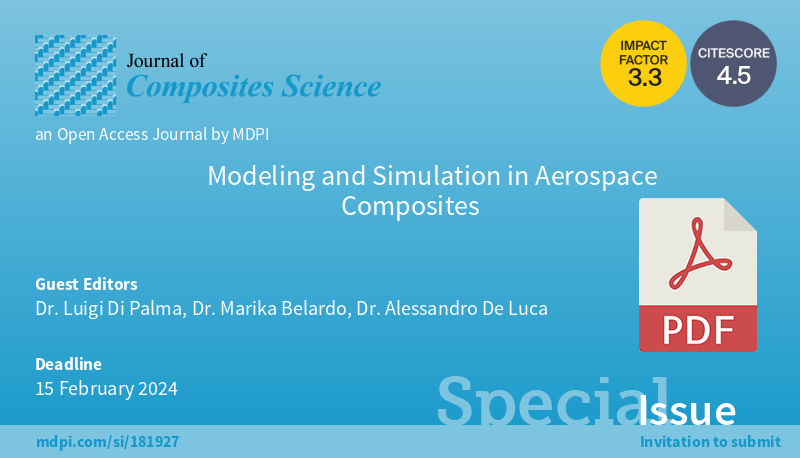
Modeling and simulation (#M&S) in #aerospace have been widely used and
increasingly improved over the years with the aims of supporting a more reliable design practice and
to aid the products’ final qualification with respect to the authorities’ rules and guidelines.
Scientists and engineers are constantly looking for a more digital qualification and certification
exploring M&S advancements and high-fidelity approaches in several disciplines. Advanced M&S methods
have demonstrated the ability to simulate highly complex composite systems’ behaviors, reducing the
amount of physical testing. Such an approach requires the development of a credibility assurance
framework (#CAF) to support risk-informed applications of advanced M&S. This is a crucial research
and innovation stream to make viable the #M&S advanced methods for practical applications in
aerospace composite. In addition, the current #aerospace innovation topics are devoted to the
development of greener aircraft and new space systems. Modeling and Simulation in Aerospace
Composites" Special. The novel M&S methods are required to take into account technical issues never
considered before such as onboard cryogenic #H2 tanks for greener aircraft and new type of ceramic
composite for the thermal protections of spacecraft.
We are pleased to invite you to contribute to this Special Issue with your
original and beyond state-of-the-art studies, methods, techniques, results and V&V experiences in
aeronautical and space composite to improve the M&S methods from theoretical, numerical and
practical point of views, with the aim of supporting the worldwide aerospace communities in making
the whole development pathway of composite aircraft and spacecraft more reliable and more
affordable.
Research areas may include (but are not limited to) the following:
- Structures strength and buckling
- Aeronautical virtual certification
- Credibility assurance framework
- Aeroelasticity and dynamics
- Crashworthiness
- Numerical formulations
- Noise detection and reduction
- Impact loads (e.g., bird strike and space debris)
- Hot structures and protection systems for re-entry spacecraft
- Multi-disciplinary optimization
- Electromagnetic compatibility
- Lighting protection
- Stealth capabilities
- Low-weight structures
Useful Information & Submission Guidelines:
Prospective authors can directly submit their paper to the online submission
platform of the Composites Science journal. Manuscripts submitted should neither be published
previously nor be under consideration for publication in another journal. The work should report
scientifically sound experiments and provide a substantial amount of new information. The article
should include the most recent and relevant references in the field. The structure should include an
Abstract, Keywords, Introduction, Materials and Methods, Results, Discussion, and Conclusions
(optional) sections, with a suggested minimum word count of 4000 words.
Special Issue:
Modeling and Simulation in Aerospace Composites
NOTE:
-
Discount of 50% for the EASN speakers
-
A special price is available to all papers submitted by Italian colleagues, by the end of
2023.
The submission system is currently open and can be found here
Submission deadline:15.02.2024
Useful Links