The architecture of Salerno has greatly been influenced by Langobard domination, while Naples
is mostly characterized by Byzantine art. Langobard people, which came from Scandinavia, arrived in Italy in the
sixth century. Their first settlement was in the Northern part of Italy, in fact, Pavia was their capital. During
the successive centuries, they moved South, so the dukedom of Benevento was founded and Salerno became part of it.
|
Amalfi Coast
|
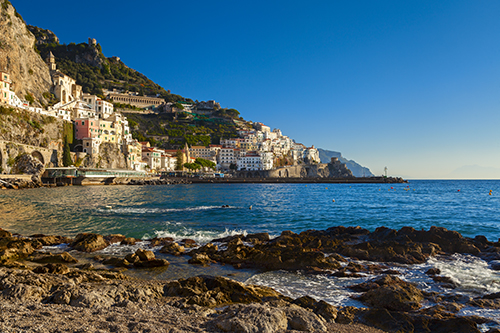
The Amalfi Coast is one of the most enchanting coastlines in Europe, for the spectacular landscape and
historic heritage of the place. The vegetable patches and the gardens are all contained in terraces, where
the products, like lemons, are cultivated from centuries. The nature of Amalfi coastline has made very
difficult and interesting the construction of the main road (named Statale 163) that connects all the
villages of the coast. This incredible road was built around 1840 and completed in 1852, and it wings around
the mountains, on cliffs varying from 50ft to 400ft above the sea, offering each corner a breathtaking sea
view.
Discover the beauty of the hiking trails along the Amalfi Coast: the Path of the Gods from Praiano to
Positano or from Praiano to Agerola, the Path of Agaves in bloom, the Path towards the Monastery of Santa
Maria a Castro, the paths that from the heart of Praiano lead to the suggestive beaches of this beautiful
location.
There are numerous hiking paths on the splendid Amalfi Coast, starting from the Coast to reach the Lattari
Mountains, giving unique sceneries and unforgettable views to the visitors and the nature lovers.
|
|
Positano
|
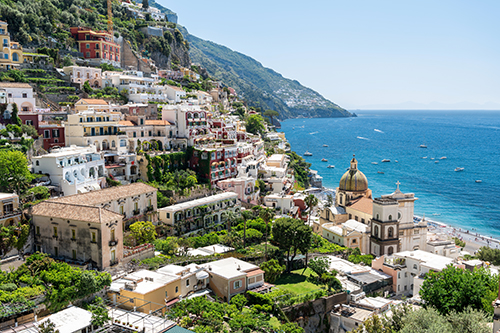
One of the most gorgeous pearl of the Amalfi Coast, worldwide famous for its beauty. Positano is synonymous
of summer fashion. Its boutiques made every summer thousands of dresses in cotton, silk and linen. The
fantasy and the geniality of their creations, whose colours are very simple like the green emerald, the
white and the yellow, always suggest the summer fashion.
More Information: https://www.positano.com/en/s/positano-3
|
|
Ravello
|
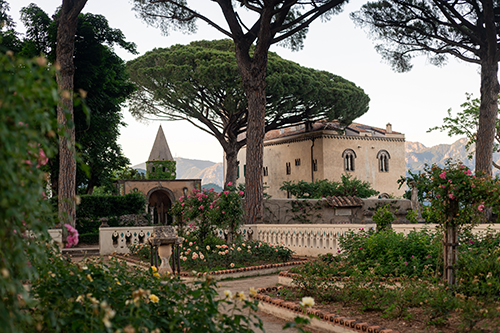
Ravello is located about 5 km from Amalfi; up on the mountains, overlooking the coast from Maiori to Amalfi.
The Villa Rufolo, from XII century, erected by the Rufolo's family and the Villa Cimbrone, are two sites not
to be missed for their splendour and their internal decorations. Both these Villas have an amazingly
beautiful garden that, if it is even possible, enhances the Villas even more. From Villa Cimbrone, you can
admire one of the most divine panoramic views of Italy, along all the Amalfi Coast, and on some days, up to
the Coast Cilentana.
Villa Cimbrone Gardens
Opening hours: Mo-Su 09:00 AM
until sunset • Fees: 7 € • View more information here
|
|
Paestum Archaeological Park
|
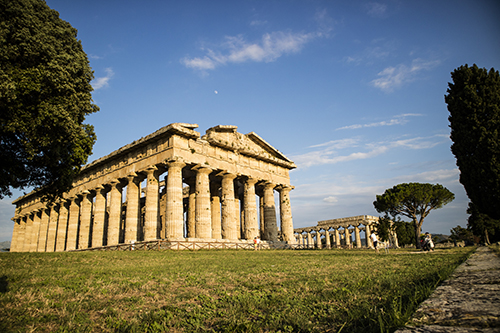
The Archaeological Park of Paestum is a UNESCO World Heritage Site. Paestum was one of the major ancient
Greek cities on the coast of the Tyrrhenian Sea in Magna Graecia. Three magnificent Doric temples overlook
the whole park. A Museum preserves stunning archaeological finds, such as the Tomb of the Diver.
Paestum was a major ancient Greek city on the coast of the Tyrrhenian Sea in Magna Graecia. After its
foundation by Greek colonists under the name of Poseidonia, it was eventually conquered by the Lucanians and
later the Romans. The Lucanians renamed it to Paistos and the Romans gave the city its current name. The
ruins of Paestum are notable for their three ancient Greek temples which are in a very good state of
preservation. Today the remains of the city are found in the modern fraction of the same name, which is part
of the community of Capaccio in the Province of Salerno.
|
|
Path of Gods
|
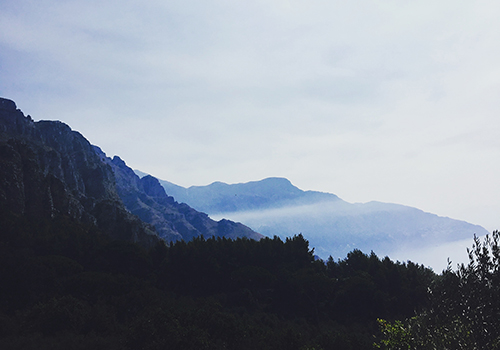
The Amalfi Coast is famous all over the world for its natural beauty, so we can't miss the Path of the Gods
as the first among the top ten things to do in the Amalfi Coast. The Path of the Gods, from where on the
clearest days you can admire in all its glory this corner of paradise, day after day, enchants several
tourists and visitors.
It is a naturalistic path on the Lattari mountains that runs along the entire coastline
for 7 km. In the fraction of Positano, Nocelle, it is perhaps the most interesting part of the Path of the
Gods. In fact, it is precisely here that the landscape becomes suggestive due to the alternation of pine
forests, caves to explore and especially spectacular glimpses of the Amalfi Coast.
|
|
Naples
|
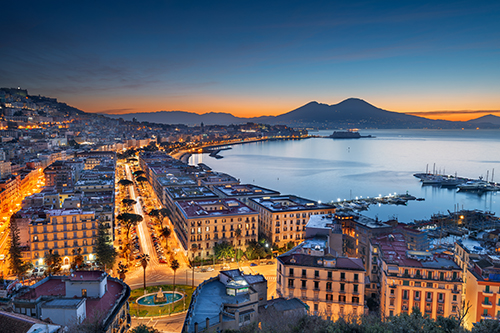
In the shadow, the Vesuvius tourism roots run deep: on the imprints of great greek columns refined
aristocrats and Roman emperors built their sumptuous villas and oasis all along the shoreline of the Gulf.
It is not a coincidence that at the beginning of this third millennium the peculiar magic of this
civilisation continues to generate new sources of amazement: the recovery of age-old monuments and
traditions – folklore, gastronomy, genuine cultivation – that were thought irreparably lost, events and
shows worthy of the great international circuit, new fodder for artistic and scientific research.
Naples’ artistic treasures to visit are countless; the old city centre, world patrimony
protected by Unesco; the buildings, the churches, the catacombs and the underground paths, the Archeological
Museum; the places of Medieval and Renaissance power around the Castel Nuovo and Palazzo Reale; the
unforgettable seafront, from Castel dell’Ovo to Posillipo. The Vomero hill area proposes museum collections
among the most important in the world, in restored locations that have been set up in an exemplary way:
Capodimonte’s Palazzo Reale and the Certosa of San Martino.
|
|
Capri
|
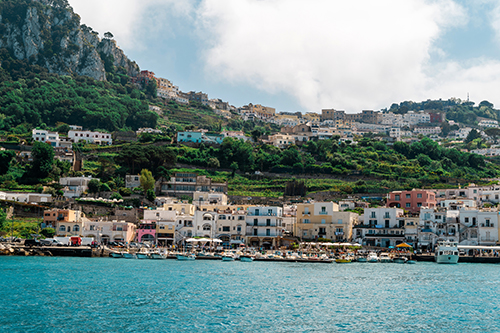
Luxuriant, extraordinary, and such a mild climate. Capri is a Mediterranean island of calcareous origin that
has been visited over the centuries by intellectuals, artists and writers, all enthralled by its magical
beauty. A mix of history, nature, worldliness, culture and events that daily blend together and bring the
Legend of Capri to life; a legend that sees no comparison anywhere in the world.
Although the majority of holidaymakers staying on Capri wouldn't dream of leaving this
paradisiacal island, not even for a minute, those lucky enough to be here for more than a week or two might
well be tempted to make the most of its strategic location in the Bay of Naples and to use it as luxurious
base from which to visit the tourist attractions on the neighboring islands and on the mainland.
Throughout the year, regular ferry and hydrofoil crossings transport passengers boarding
at Capri to the nearby ports of Naples and Sorrento. In the summer months, ferry connections are also
available to and from the Amalfi Coast. Those who have always fancied sailing the seas in authentic Capri
style can rent a boat, with or without skipper, in the harbour of Marina Grande.
More Information:
www.capri.net
|
|
Ischia
|
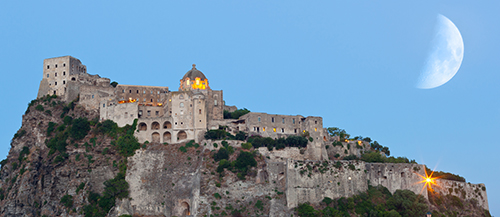
Ischia is a volcanic island in the Tyrrhenian, at the northern end of the Gulf of Naples. It is almost
entirely mountainous, with the highest peak being Mount Epomeo at 788 meters. The island has a population of
over 60,000 people.
The community areas in Ischia include ischia Porto (the main Comune of the island),
Barano, Casamicciola, Forio, Lacco Ameno and Serrara Fontana. Ischia is a rare beauty and wellness legacy,
an island that celebrates life. 2700 years of history, 103 thermal wellness springs and the largest of the
Neapolitan islands, about 30 km from Naples, measuring 10 km from east to west and 7 km from north to south,
with 34 km of shoreline. Its highest peak is Mount Epomeo (787 m.). The climate is mild all year round.
Throughout Italy and the rest of the world, Ischia is very high on the list of places
for its capacity to accommodate tourist requirements and for its variety of environments and natural
beauties whose harmonic complexity has a particular attraction and charm for the tourist, who, nearly
always, return to island to recover the strength of their bodies and spirits
More Information: www.ischia.it
|
|
Pompeii
|
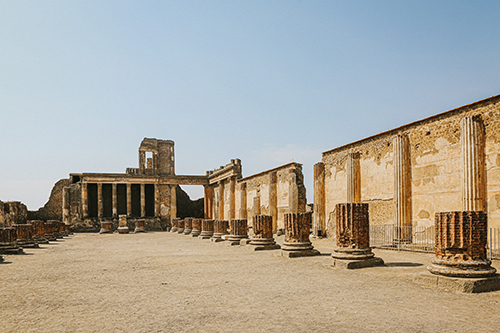
Ancient pagan town, buried by about six meters of ash and lapilli following an eruption of Vesuvius, which
took place in August 79 AD where many people were dead. In the sixteenth century, it was discovered almost
by chance during the construction of an aqueduct and as a proof of this, a plaque has been placed near the
Door Nocera. By decree of 1997 Pompeii was included among the sites that are considered World Heritage by
UNESCO. The Committee has decided to enter this area on the basis of cultural criteria considering that the
extraordinary findings in the city of Pompeii and neighbouring cities, buried by the eruption of Vesuvius in
79 d.C., constitute a complete and living testimony of society and daily life in a moment of the past and
cannot find their equivalent anywhere in the world.
Pompeii Archaeological Park
Opening hours: Mo-Su 09:00 AM-18:00 PM • Fees: 15 € • View more information here
|